A NAFTA/FTAA Rogues’ Gallery
William F. Jasper

|
The New American, April 5, 2004
A behind-the-scenes look at some of the key globalist architects and apparatchiks responsible for launching and promoting NAFTA, FTAA and other “free trade” traps. |
The North American Free Trade Agreement (NAFTA) went into effect on January 1, 1994, amid great hoopla and promises that it would bring a continuous wave of progress and prosperity to all three nations involved: Mexico, Canada and the United States. Although some U.S. businesses have indeed benefited from the new arrangement, many others have not. Thousands of businesses and millions of jobs, especially in manufacturing, have fled the U.S. for Mexico, China and elsewhere. Many critical skills, technologies and production plants have disappeared from America’s economic landscape.
Another major promise of the “Free Trade” advocates was that once NAFTA went into effect, Mexico would experience dynamic economic growth and, as a result, there would be little or no incentive for Mexicans to move to the U.S. The decades-long massive influx of illegal aliens would end. Unfortunately, that has not been the case; over the past 10 years, the deluge of illegal migrants has grown steadily worse.
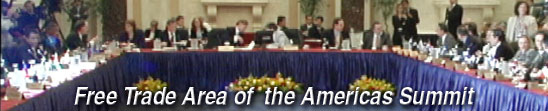
Far more serious than NAFTA’s economic and immigration consequences, however, is the dangerous threat it presents to our national sovereignty. As we pointed out during the ratification debate, if NAFTA were truly about freeing up trade, the agreement wouldn’t have required 2,000 pages of legalese establishing dozens of governing councils, committees, commissions, working groups and tribunals concerned not only with trade but also with environmental and labor standards, as well as other matters. Now, the same forces that designed and promoted NAFTA are insisting that it must be “broadened” and “deepened” under the proposed Free Trade Area of the Americas (FTAA). By “broadened” they mean that NAFTA must be expanded geographically to include all 34 nations of the Western Hemisphere, with the exception (for now) of Communist Cuba. And by “deepened” they mean that NAFTA must be strengthened politically to allow for hemispheric governance and regulation on matters of education, health care, immigration, security, population, unemployment, agriculture, workplace safety, transportation, energy — virtually every area that is now under the sovereign jurisdiction of the nation-state and its political subdivisions.
In 1992 and 1993, the campaign to pass NAFTA built to a heated crescendo. However, few American citizens — on either side of the NAFTA debate — realized that the whole process had been put in motion decades before and systematically built into a seemingly unstoppable force. Although Presidents George Bush (the elder) and Bill Clinton were the most visible figures associated with the campaign for NAFTA, they were merely fronting for much more powerful forces operating behind the scenes.
Regular readers of THE NEW AMERICAN are very familiar with the Council on Foreign Relations (CFR) and the Trilateral Commission (TC), two of the premier organizations dedicated to undermining the U.S. Constitution and submerging the United States in a global government. Leaders and members of these two pillars of the Establishment have provided the critical economic and political impetus for NAFTA and the FTAA.
In addition, there are several organizations focused specifically on Latin America that have provided essential support for the effort to merge the countries of the Western Hemisphere. The most important groups in this category include the Council of the Americas (COA), the Americas Society, and the Inter-American Dialogue (IAD). These organizations, founded by David Rockefeller and dominated by CFR and TC members, have, over the course of the past three decades, drawn many business, political, media and academic leaders in the U.S. and Latin America into the globalist camp. The influence of these groups is immensely enhanced by their close association with central banks, major private U.S. banks, and multilateral lending institutions such as the World Bank, IMF, and Inter-American Development Bank. (These banking institutions are also dominated by CFR and TC members.)
As a result, what appears to be a popular, widespread and organic “movement” to “integrate” the hemisphere is, in reality, an entirely contrived façade, propped up by a relative handful of one-world elitists, numbering no more than several hundred. Their advantage is that they are very well organized, well funded, and strategically placed in highly leveraged positions of power and influence.
In the remainder of this article we profile key members of this coterie of Insiders who aim at nothing less than the destruction of our freedom. The individuals described below represent a number of different levels and functions in this perfidious plot against America.
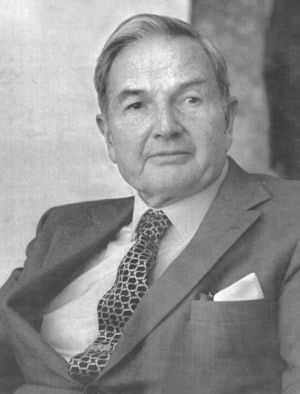 |
| David Rockefeller |
David Rockefeller — No other individual comes close to matching the influence that David Rockefeller has exerted over U.S.-Latin American relations — through both Democratic and Republican administrations — over the past five decades. And no other individual has been as instrumental in the design, promotion and implementation of NAFTA, FTAA and other regional schemes. In his April 23, 1992 address to the Forum of the Americas, President George Bush (the elder) paid public homage to Rockefeller’s key role, saying: “David, thank you, sir. And thank you for your really vital work in rallying the private sector and congressional support for the North American Free Trade Agreement.... And let me say to his many friends here that David’s personal involvement has been a major factor in the success we’ve enjoyed so far.” President Clinton, President George W. Bush, Vice President Dick Cheney and U.S. Trade Representative Robert Zoellick, likewise, have all publicly praised Rockefeller as an indispensable force in the process of hemispheric convergence.
The 89-year-old Rockefeller has combined his family’s dynastic wealth and business contacts with a formidable array of organizational power bases at the global and hemispheric levels. He was founder and chairman of the Council of the Americas, the Americas Society, and Forum of the Americas, through which he has exercised enormous influence over the thinking and policies of U.S. and Latin American business and political elites. He founded the David Rockefeller Center for Latin American Studies at Harvard University and has funded the Latin American studies programs at many other institutions. As chairman of the Chase Manhattan Bank, he has intertwined his business dealings with the operations of the IMF, World Bank, Inter-American Development Bank and US AID. He has also been one of the main voices on Wall Street for increasing U.S. taxpayer funding for these globalist institutions.
In addition, Mr. Rockefeller is the founder and honorary chairman of the Trilateral Commission, as well as a continuing power within the Council on Foreign Relations (he was CFR chairman for 15 years) and a major financial angel of the Institute for International Economics, all of which have been at the forefront of the push to establish sovereignty-eroding regional trade pacts.
At the end of World War II, Rockefeller was named secretary of a special CFR study group headed by Charles M. Spofford to plan the merger of Western Europe. That CFR plan became known as the Marshall Plan, which was soon funneling millions of U.S. dollars to European socialists and business leaders who would sell out their countries and work to establish a supranational governing structure for Europe. The Marshall Plan’s ostensible purpose, fighting Communism, was intended to justify the cost to U.S. taxpayers.
The Common Market was formed as a supposed “free trade” pact and has, by design, morphed into the European Union, a continental monstrosity that is destroying what remains of its members’ residual national sovereignty and is rapidly being transformed into a socialist tyranny. Mr. Rockefeller, the last living member of the CFR study group that devised the EU scheme, has utilized the same ploys and deceptions that worked so successfully in that long-running ruse to advance the treasonous NAFTA-FTAA conspiracy here in the Americas.
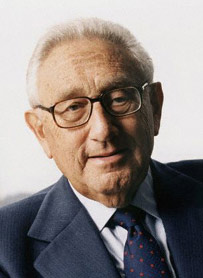 |
| Henry Kissinger |
Henry Kissinger — Dr. Kissinger’s handprints have been all over the drive to establish the FTAA. In 1993, as NAFTA was about to be officially launched, Henry Kissinger said of the trade agreement: “It will represent the most creative step toward a new world order taken by any group of countries since the end of the Cold War, and the first step toward an even larger vision of a free-trade zone for the entire Western Hemisphere.” NAFTA “is not a conventional trade agreement,” he noted, “but the architecture of a new international system.” Dr. Kissinger, a high-level Insider and member of the CFR and Trilateral Commission, knew that the trade agreement label was merely a deceptive cover story to mask the truly treasonous intent of the document’s authors: to destroy the national sovereignty of the United States and all other countries of the Western Hemisphere.
Kissinger, who served as national security adviser to President Richard Nixon and secretary of state under both Nixon and Ford, has turned his career of treachery into an extremely lucrative business as one of the highest paid consultants on the planet. His Kissinger Associates boasts some of the world’s largest corporations as clients. His client list also contains foreign governments, including Communist regimes with which he is a most enthusiastic collaborator. In the new world order envisioned by one-worlders like Kissinger, the United States would gradually be transformed and merged with these regimes in a global socialist state. That supranational state would be ruled by a superior elite, of which he, no doubt, considers himself to be a prime exemplar.
In 1997, Kissinger authored a pro-FTAA op-ed for the Los Angeles Times entitled, “Expand Free Trade To All Western Hemisphere.” In 1998, Kissinger and Associates Managing Director David Rothkopf (CFR) was a major participant in an elite conference of globalist Insiders sponsored by Inter-American Dialogue (IAD) that was entitled, “Preparing for the FTAA Negotiations: How to Achieve a Successful Launch.” Bill Clinton’s former chief of staff and “special envoy to the Americas,” Thomas “Mack” McLarty (CFR), has been representing Kissinger at most of the FTAA-related events. (For more on McLarty, now president of Kissinger McLarty Associates, see: www.stoptheftaa.org/gallery/thomasmclarty.html)
 |
| Thomas F. McLarty III |
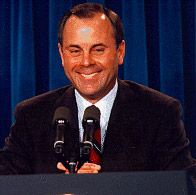
Thomas F. McLarty III — Thomas “Mack” McLarty is probably best remembered as President Bill Clinton’s White House counselor and chief of staff (1992-1994). He also served as Clinton’s “special envoy to the Americas,” in which capacity he was a key mover and shaker in the creation of NAFTA, FTAA and other trade agreements. As a top official at the 1994 Miami Summit of the Americas, McLarty offered an interesting — and under-reported — perspective: “[T]his summit is much broader than [lowering tariffs], and that’s how it should be looked at. This is not a trade summit, it is an overall summit. It will focus on economic integration and convergence.”
McLarty’s fellow globalists knew what that meant, but very few average, loyal Americans saw this comment, or would have realized its significance even if they had seen it. Most, probably, would not have realized that this was a bald admission that the NAFTA/FTAA architects were consciously working to torpedo our Constitution and our sovereignty.
Top one-world Insider Henry Kissinger was sufficiently impressed with McLarty’s performance to offer him a coveted partnership in his high-powered global consultant business and to name him president of Kissinger McLarty Associates. McLarty is also a board member of Rockefeller’s Council of the Americas and Inter-American Dialogue. He is not only a member of the CFR but has been a leading participant in a number of the council’s major events, such as its May 2000 conference on Latin America and its 2001 press briefing on the Quebec Summit of the Americas. In 2001 he also co-chaired the Carnegie Endowment panel that recommended adoption of Mexican President Vicente Fox’s so-called migration policies to do away with the U.S.-Mexico border.
 |
| Robert Zoellick |
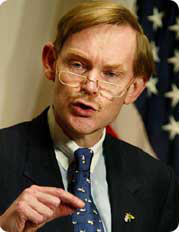
Robert Zoellick — As U.S. Trade Representative for President George W. Bush, Mr. Zoellick has presided over the most active and aggressive push for multilateral and bilateral trade agreements in U.S. history. Now in the limelight, he was a lesser-known but major architect of the CFR trade assault on U.S. sovereignty over the past two decades. He served as a top lieutenant to James Baker III (CFR) in the Reagan and Bush administrations, where he helped negotiate the NAFTA agreements, create the WTO and lay the groundwork for the FTAA.
Zoellick’s board memberships, the Washington Post’s Steven Pearlstein wrote in 2001, “read like the directory of the internationalist establishment: the Council on Foreign Relations, the German Marshall Fund, the International Institute for Strategic Studies, the Johns Hopkins School of Advanced International Studies, the Nixon Center for Peace & Freedom, the Aspen Institute, and, naturally, the Trilateral Commission.” In addition, noted Pearlstein, the U.S.’s top trade guru “serves on advisory boards to the Pentagon and the CIA.” To which we could also add his positions as director or adviser for the European Institute, the Overseas Development Council and the Institute for International Economics.
 |
| Robert Bartley |
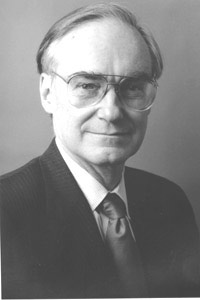
Robert Bartley — As editor of the Wall Street Journal, Mr. Bartley provided one of the most powerful and strategic voices for the globalist onslaught against America for three decades. Posing as a conservative free-market Republican, Bartley used the news and editorial pages of the Journal to promote neoconservative internationalists and to propagandize for NAFTA, FTAA, WTO, IMF, World Bank and other globalist institutions and programs. He once said “I think the nation-state is finished” — and he did everything within his power to terminate our nationhood. A zealous advocate for unrestricted immigration, he editorialized in favor of a constitutional amendment that would state simply: “There shall be open borders.”
Bartley, who passed away in December 2003, was a member of the CFR and Trilateral Commission, as well as a speaker at the annual World Economic Forum and an attendee of the super-secretive Bilderberg meetings. For more on Robert Bartley’s reign at the Wall Street Journal, see “The Nation-State Is Finished,” in the February 23, 2004 issue of TNA.
 |
| Kenichi Ohmae |
Kenichi Ohmae — When Wall Street Journal editor Robert Bartley made the startling statement quoted above about the nation-state being finished, he also commented that it was Kenichi Ohmae who had led him to that conclusion. Dr. Ohmae received his Ph.D. in nuclear engineering from MIT, but he is most famous for his best-selling books on business and economics and his articles in the Wall Street Journal, Harvard Business Review, Foreign Policy and The Economist. Among the more than sixty books he has authored are such paeans to one-worldism as The Borderless World and The End of the Nation State: The Rise of Regional Economies. In his 1993 essay “The Rise of the Region State” for Foreign Affairs, the house journal of the Council on Foreign Relations, Ohmae declared: “The nation state has become an unnatural, even dysfunctional, unit for organizing human activity and managing economic endeavor in a borderless world.” Due to the eminence that has been bestowed on Ohmae by the CFR opinion cartel, his works have succeeded in convincing many that nationhood is indeed headed inevitably for extinction, to be replaced by a new order of global governance.
 |
| Peter Hakim |
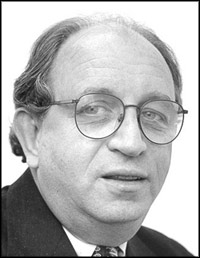
Peter Hakim — As president of Inter-American Dialogue (IAD), Mr. Hakim frequently testifies before Congress and appears on national television and in the op-ed pages of major newspapers to expound on U.S.-Latin American relations. He writes a regular column for the Christian Science Monitor and provides essays on hemispheric affairs for the CFR journal, Foreign Affairs. A former apparatchik for the revolutionary Ford Foundation in Latin America, Hakim promotes the agenda of the Left for the U.S. foreign policy Establishment, defending Fidel Castro’s Communist regime and advocating U.S. normalization of relations with Cuba. He currently serves on boards and advisory committees for the Foundation of the Americas, the World Bank, the Inter-American Development Bank, and Human Rights Watch. He is a member of the Council on Foreign Relations and frequently appears as a panelist or speaker on CFR programs.
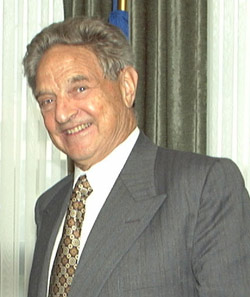 |
| George Soros |
George Soros — One of the world’s wealthiest men, multi-billionaire currency speculator George Soros has poured hundreds of millions of dollars into radical and subversive causes throughout the world. His Soros Foundations and Open Society Institute operate in more than 50 countries in Europe, Central Asia, Africa and Latin America, dispensing funds for legalizing drugs, criminalizing private gun ownership, ending the death penalty, and promoting the United Nations, foreign aid and environmental extremism. While Soros claims to promote entrepreneurship and free market reform in the former Soviet Union and Eastern Europe, his critics in those countries point out that his funding rarely goes to genuine reformers. Instead, it seems invariably to go to “former” members of the Communist nomenklatura who continue to dominate and oppress their harried citizens.
It is not surprising then that Soros is a boon companion to former Soviet dictator Mikhail Gorbachev and was a top-billed player at Gorbachev’s 2000 Millennium Summit in New York City. He is a member of the Trilateral Commission and a director of the Institute for International Economics. He is also a CFR director, and his Soros Fund Management is a CFR corporate member, providing generous funding for the globalist agenda. Soros has presided at CFR conferences, including confabs on Latin America and the FTAA. Arminio Fraga, former president of Brazil’s Central Bank and managing director of Soros Fund Management, is a member of Inter-American Dialogue.
Soros is infamous for his devious (even criminal) use of these contacts and insider information to destabilize foreign currencies and cause gyrations that enable him to make enormous profits — while wiping out the savings of millions of poor people from Indonesia to Peru. In 2000, he funneled more than $1 million in illegal campaign contributions to leftist Peruvian president and cocaine user Alejandro Toledo. Much of that money was used to foment riots in Lima that left six dead and hundreds injured, and caused millions of dollars of property damage. Soros profited handsomely but continued to play the part of the munificent philanthropist with his ill-gotten gains.
 |
| C. Fred Bergsten |
C. Fred Bergsten — Over the past three decades, Bergsten, a former assistant secretary of the U.S. Treasury, has been one of the most important architects of U.S. and global economic policy. Upon leaving the Carter administration in 1981, he took over as director of the newly founded Institute for International Economics (IIE), largely the creation of David Rockefeller (who continues to serve on the IIE board of directors). The chairman of the IIE is Peter G. Peterson, who also chairs the CFR. Mr. Bergsten is a director of the CFR as well as a member of the Trilateral Commission.
Martin Walker of The London Observer has described the IIE as maybe “the most influential think-tank on the planet,” with an extraordinary record for “turning ideas into effective policy.” Some of the ideas IIE has turned into policy include NAFTA, the WTO, the FTAA and APEC (the Asia-Pacific Economic Community). Bergsten is a leading economic theoretician and propagandist for the new world order, having authored, coauthored, or edited 29 books and hundreds of articles on a wide range of international economic issues. He is assisted at IIE by a large battery of globalist scholars, among whom IIE Senior Fellows Gary Hufbauer (CFR) and Jeffrey Schott have been particularly important as economic technicians and propagandists for the FTAA.
 |
| Alan Greenspan |
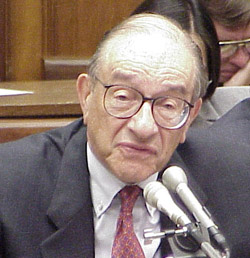
Alan Greenspan — As chairman of the U.S. Federal Reserve System, Mr. Greenspan occupies one of the most powerful positions on the planet, capable of creating or destroying fortunes with the most minute change of policy, or sending global markets into a panic with a single utterance. He has been one of the most influential advocates of NAFTA and the FTAA, and has effectively used the prestige and power of his office to win support for these schemes from much of the Republican Party leadership, the U.S. business community, and the Latin American business and political elites.
Mr. Greenspan is a longtime CFR member and a frequent attendee and featured speaker at CFR events. He is also a former director (and currently an honorary director) of the IIE. Other current and former Federal Reserve officers also play key roles in a massive Insider push for a hemispheric regional state. Former Federal Reserve Chairman Paul Volcker (CFR, TC, IIE), New York Federal Reserve President William McDonough (CFR director), New York Federal Reserve Chairman Peter G. Peterson (CFR chairman), Chicago Federal Reserve Chairman Michael Moskow (CFR director), and others have been active in lobbying for the NAFTA-FTAA agenda among U.S. leaders as well as their central bank counterparts in Latin America.
 |
| Roberto Mangabeira Unger |
Roberto Mangabeira Unger — Although completely unknown to the American public, Professor Unger is very well known among the movers and shakers in elite political, economic and academic circles. He is a Brazilian and a radical Marxist who has spent the last 30 years teaching and writing at Harvard University’s Law School. He also teaches at Yale University and the David Rockefeller Center for the Study of Latin America. Together with Mexican Communist militant Jorge Castañeda, Unger launched Latin America Alternative, a coalition of leftist intellectuals and political leaders. Unger became the mentor and ideological guru of Vicente Fox, now president of Mexico, and Castañeda became, for a time, Fox’s foreign minister. Unger and Castañeda are both active as featured speakers at Insider forums sponsored by the COA, IAD, CFR, etc. Castañeda, who now teaches at New York University, was the honoree and main speaker at the CFR’s “History Maker Series” program at the council’s New York City headquarters on January 29, 2004.
 |
| Zbigniew Brzezinski |
Zbigniew Brzezinski — In his 1970 book Between Two Ages, Columbia University Professor Zbigniew Brzezinski (CFR) proclaimed that the United States is obsolete, that “national sovereignty is no longer a viable concept,” and that world leaders must work toward gradual economic and political “convergence” of nations, with the final aim being “the goal of world government.” In 1972, while brainstorming at a Bilderberg conference, David Rockefeller and Mr. Brzezinski decided to push forward the idea of forming the Trilateral Commission to further this objective. Rockefeller later recalled that he asked his Polish protégé to “shepherd the effort” to create the elite new body of globalists from three continents (Europe, Asia and North America — hence the “Trilateral” designation). Brzezinski was appointed as the commission’s first director. Subsequently, he was appointed to tutor Georgia Governor Jimmy Carter in world affairs, and later became President Carter’s national security adviser.
In his address to Mikhail Gorbachev’s 1995 State of the World Forum, Brzezinski lamented that with only five years to the start of the new millennium, “We do not have a new world order.” “We cannot leap into world government in one quick step,” Brzezinski told his audience. Such a lofty goal, he said, “requires a process of gradually expanding the range of democratic cooperation as well as the range of personal and national security, a widening, step by step, stone by stone, [of] existing relatively narrow zones of stability in the world of security and cooperation. In brief, the precondition for eventual globalization — genuine globalization — is progressive regionalization, because thereby we move toward larger, more stable, more cooperative units.” (Emphasis added.) This describes precisely the gradualist regional approach to global government proposed through the FTAA. Brzezinski continues as a prominent advocate of this process in his books and articles, in his lectures at the School of Advanced International Studies at Johns Hopkins University, and in his continuing leadership at the Trilateral Commission, CFR and other Insider institutions.
|