Pincer Strategy Behind the FTAA
by William F. Jasper

|
The New American, May 21, 2001
Street-level radicals are making it easier for pinstripe revolutionaries to transform their “free trade” rhetoric into regional governance — all according to plan. |
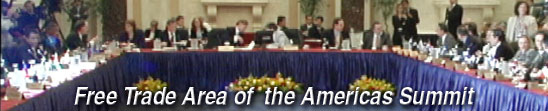
The scenes from the Quebec “Summit of the Americas” were all too familiar: presidents, prime ministers, and economic ministers clinking glasses and toasting new victories for “free trade” and “free markets,” while television news programs featured economic commentators, corporate CEOs, and bankers extolling the multiple advantages of a hemispheric trade bloc.
President George W. Bush was the Summit’s headliner, meeting with the heads of 33 other nations of the Western Hemisphere for the launch of a proposed Free Trade Area of the Americas (FTAA). This new FTAA would represent an expansion of NAFTA (the North American Free Trade Agreement) from the current three members — Canada, the U.S., and Mexico — to include all countries of the Hemisphere, from “Alaska to Tierra del Fuego.”
Wondrous benefits will accrue to everyone concerned, the FTAA architects promised. Globalization, open borders, and the free movement of people, products, and capital will bring “a rising tide of prosperity that will lift all boats.”
Alongside these scenes were other familiar sights less cordial: marching, chanting, defiant demonstrators; clashes with police, tear gas, riots, fires, violence and anarchy; and an odd mélange of slogans and banners mixing defense of national sovereignty with environmental extremist cant and Marxist rant.
We’ve seen all this before, notably, at the 1999 World Trade Organization summit, now remembered as the infamous “Battle in Seattle.” (See “Organized Anarchy” in the June 19, 2000 issue of TNA.) The Seattle debacle was repeated a few months later at the IMF-World Bank conference in Washington, D.C., then again at the IMF meeting in Prague, Czech Republic, and still again at the European Union summit in Nice, France.
Colossal Charade
It’s a familiar charade formula that we’ve seen over and over again — and, no doubt, will see many more times in the future. Charade? Yes, indeed, a colossal charade operating on several levels. At one level, the charade involves a huge deception by politicians and corporate socialists posing a “free trade agreement” to cover what is, in truth, a revolutionary scheme to destroy national sovereignty and create an unaccountable, regional superstate.* At another level, the charade involves the use of “controlled opposition”: creating or co-opting groups and individuals who will, by their extreme rhetoric and actions, make the FTAA advocates look moderate and reasonable by comparison. Thus the scruffy rent-a-mob radicals who take to the streets at these events, and their more urbane left-wing comrades in academe and Congress who can be counted on to make the wrong arguments and to cave in at the crucial moments.
In this stage-managed charade, the “leading” proponents and opponents are, in reality, the connected, coordinated arms of a deadly pincer attack. They are opposing arms on the same hairy body.
This fact will not be reported by CNN, CBS, PBS, ABC, or in the pages of the New York Times, the Los Angeles Times, the Wall Street Journal, Time, or Newsweek. These and other organs of the Establishment press are key elements in sustaining this deceptive and treasonous scheme. The people who run these so-called news organizations have no more intention of reporting the truth than do the Communist editors of the People’s Daily in Beijing.
The purpose of these media organs is not to enlighten, but instead to confuse, to create a great “booming, buzzing confusion” that will distract public attention from the ongoing efforts of the one-world managerial elites who are constructing their global new world order.
The phrase “booming, buzzing confusion” comes from an important article authored by Columbia University law professor and veteran State Department official Richard N. Gardner (most recently, the Clinton administration’s ambassador to Spain). The article was entitled “The Hard Road to World Order,” and appeared in the April 1974 issue of Foreign Affairs, a journal which Time magazine calls “the most influential periodical in print.” The influence of Foreign Affairs derives, of course, from the fact that it is the official house organ of the organized one-worlders at the Council on Foreign Relations, or CFR.
The “Hard Road” article began with CFR member Richard Gardner’s lamentation that like-minded internationalists had failed to achieve what he termed “instant world government.” He proposed a new and more effective route to the creation of an all-powerful, global superstate, asserting:
In short, the “house of world order” will have to be built from the bottom up rather than from the top down. It will look like a great “booming, buzzing confusion,” to use William James’ famous description of reality, but an end run around national sovereignty, eroding it piece by piece, will accomplish much more than the old-fashioned frontal assault.
Thus the great booming, buzzing confusion we witnessed in Quebec — as in Seattle, Washington, D.C., Prague, Nice, etc. — is a smoke screen to mask the real agenda and the real handlers behind this “bottom up” construction of “world order” through regional blocs.
CFR Plot
A careful examination of this “bottom up” effort quickly reveals that it is directed from the top down. The top in this case, as in so many others, is Pratt House, the CFR headquarters in New York City.
Like the slime trail that leads to a slug, virtually every trail of American policy disaster leads back to the Pratt House globalists.
The Quebec Summit, like the 1994 Summit of the Americas in Miami, where the 34-nation Free Trade Area of the Americas was launched, was completely a production of the CFR and the Rockefeller family. As we noted in these pages following the Miami event, the Summit of the Americas and the FTAA were conceived, nurtured, and brought to fruition by the Council of the Americas (David Rockefeller, founder and honorary chairman), the Americas Society (David Rockefeller, chairman), the Forum of the Americas (David Rockefeller, founder), the U.S. Council of the Mexico-U.S. Business Committee (Rodman C. Rockefeller, chairman), the Council on Foreign Relations (David Rockefeller, former chairman), the Trilateral Commission (David Rockefeller, founder and honorary chairman), the Chase Manhattan Bank (David Rockefeller, former chairman), and the Institute for International Economics (David Rockefeller, financial backer and board member).
The Miami summit had come close on the heels of the globalists’ victorious passage of NAFTA (accomplished thanks to plentiful lying, bribing, arm-twisting, and deceiving). Avid one-worlder Henry Kissinger, a member of the executive committee of the Trilateral Commission and a longtime power in the CFR, called the vote on NAFTA the single most important decision that Congress would make during Mr. Clinton’s first term. Indeed, Kissinger admitted in the Los Angeles Times in 1993 that passage of NAFTA “will represent the most creative step toward a new world order taken by any group of countries since the end of the Cold War....” NAFTA “is not a conventional trade agreement,” he said, “but the architecture of a new international system.”
It was not surprising, then, to see representatives from this same Rockefeller-CFR nexus put forward as the media-anointed “experts” on all FTAA matters at Quebec. Foremost among these was C. Fred Bergsten (CFR), executive director of the Institute for International Economics (IIE ) and a former U.S. assistant secretary of the Treasury for international affairs. According to Bergsten, President Bush and the U.S. Congress must push forward on the fast track with the FTAA.
Follow the Money
The IIE, according to Martin Walker of The London Observer, “may be the most influential think-tank on the planet.” Who provides the funds to make this “think-tank” so influential? According to the IIE’s own reports, its major funding comes from the German Marshall Fund and the Ford, Hewlett, Tinker, Starr, and Mellon foundations (to name a few). These are the same globalist foundations that are also funding the folks who were demonstrating and rioting against the WTO, NAFTA, IMF, and FTAA.
A search of the annual reports or the Internet websites of these foundations and/or those of the anti-FTAA radicals, will find, for instance, that Ralph Nader’s Global Trade Watch is also funded by the same CFR-directed foundations that finance the pro-FTAA groups. Nader and his top lieutenant, Lori Wallach, have been designated by the CFR media elites as the prime spokespersons for the anti-FTAA mob. Which is very convenient, since the main Nader-Wallach gripe is that the NAFTA-WTO-FTAA organizations are too conservative, they have not usurped enough powers from the nation states.
This same argument is made by Nader-Wallach comrade John Cavanagh. Cavanagh is director of the Institute for Policy Studies (IPS), the infamous, hardcore Marxist network that has been wired into the Soviet KGB and Fidel Castro’s DGI since the 1960s. On April 17th, as the Quebec Summit was preparing to open, Cavanagh appeared on an FTAA press briefing panel sponsored by the CFR. According to Cavanagh, the NAFTA-WTO-FTAA regimes can only be legitimized if they take on supra-national powers over environmental, labor, education and health issues, as well as trade.
Echoing the Nader-Wallach-Cavanagh line are a host of radical enviro-fanatics, all of whom receive beaucoup funding and friendly media treatment from the same Pratt House-dominated foundations and media organs. Check the “news” stories and websites for the Rainforest Action Network, Earth First!, Greenpeace, Sierra Club, etc., and you will understand why these “Watermelon Marxists” (green on the outside, red on the inside) continue to get the CFR funding and media promotion.
In a 1990 interview with E Magazine, David Brower, known as the “Archdruid” of the radical greens, explained the subversive process of constantly moving debate, public perceptions, and policy ever leftward: “The Sierra Club made the Nature Conservancy look reasonable. I founded Friends of the Earth to make the Sierra club look reasonable. Then I founded Earth Island Institute to make Friends of the Earth look reasonable. Earth First! now makes us look reasonable. We’re still waiting for someone else to come along and make Earth First! look reasonable.”
But Brower didn’t wait. This Establishment-blessed watermelon Marxist helped launch the more radical Rainforest Action Network, run by his old Earth First! comrade Mike Roselle. And Roselle has gone on to form the anarchist Ruckus Society — which played a prominent role in the demonstrations in Seattle and Quebec. All of which is intended to make venerable green Bolsheviks like Brower look eminently reasonable — and power-grabbing CFR one-worlders appear positively conservative by comparison.
* Fantastic? No, this is exactly the strategy that was employed in Europe in order to create what is now known as the European Union and is now widely recognized as a developing regional government. But the EU, recall, was once known as the “Common Market” and was once sold to unsuspecting Europeans as a “free trade” arrangement. The architects of world order view the Common Market-EU as the perfect model for NAFTA-FTAA — except that they hope to accomplish in several years’ time with NAFTA-FTAA what has taken five decades with the Common Market-EU. A more extensive history and documentation of this Insider game plan was recently provided in this magazine (see “Global Tyranny … Bloc by Bloc,” by William F. Jasper, in the April 9th issue of TNA).
|