Engineered Extinction
William F. Jasper

|
The New American, December 1, 2003
Government policies threaten our jobs, economy and national security by destroying America’s basic resource industries — mining, forestry, farming and ranching. |
Imagine an America of closed factories, shuttered offices, and millions of unemployed blue-collar and white-collar workers. Imagine a United States of America that is no longer the leader in any major industrial or technological sector — a U.S. of A. that is dangerously dependent on foreign suppliers for many of its critical military supplies and weapons components. Imagine an America that depends on foreign producers not only for virtually all consumer goods but even for basic foodstuffs. Imagine an America that is no longer a land of optimism and opportunity for our younger generations because it has ceased to be competitive globally and has regulated jobs, careers and entrepreneurial activities into oblivion. Imagine a rusting and decrepit America that can no longer economically support its aging population. Imagine a dependent America with supplies of food, oil and other essentials interrupted by war or terrorism. Imagine regular electrical blackouts and brownouts similar to those that afflict developing countries.
Not a pretty picture. But, unfortunately, the above imaginings are gradually becoming reality. We are witnessing the piecemeal economic destruction of the wealthiest, most dynamic economic powerhouse in human history. The American economy is dying, but not from natural causes. It is being strangled to death in a coordinated pincer attack. America’s ability to survive, produce and prosper is being systematically destroyed by socialistic taxes and regulations that make U.S. production of virtually everything increasingly uneconomical. Simultaneously, the same legislators and government officials who are impeding American producers are opening the floodgates to cheap foreign goods that are not burdened with the same debilitating taxes, regulations and mandates.
The hemorrhaging of U.S. manufacturers and manufacturing jobs to Mexico, China and other overseas destinations has been a topic of heated controversy for decades. In the past couple of years, the outsourcing of information technology jobs and the transfer of hi-tech facilities to India, China and Pakistan have also caused outcries of concern. Far less has been heard of the similar woes besetting our basic resource industries — farming, ranching, mining and timber — and the major inroads that foreign competitors (including our declared enemies) have made into these critical areas.
Even the most insulated and naïve urbanite knows (we hope) that the meat, eggs, bread, fruit and vegetables on the dinner table came from a farm or ranch. We know that the gasoline in our tanks, the heating oil or natural gas for our homes, and the steel, aluminum and other metals we use each day had to be extracted from the earth. The paper, lumber and other wood products that are essential to our lives came from trees.
The average American urban consumer understands these simple facts — but at a very elementary level. The overwhelming majority of Americans have no direct contact with the people who produce the essentials of everyday life — food, clothing, shelter and energy — and make all of our other hi-tech and service industries possible. Joe Consumer has little to no appreciation for the tightening straitjacket that America’s farmers, ranchers, miners and timber harvesters have been put in, and he is largely clueless about how the assault on these domestic industries will dramatically impact him.
Joe Consumer must wake up to real-world facts and shake off the pernicious fantasies sown by the fanatics of both the environmental and “free trade” lobbies. Our basic resource industries, suffering from decades of regulatory overkill and nearly a decade of added burdens from the North American Free Trade Agreement (NAFTA), are now being targeted for more intensive foreign penetration under the proposed Free Trade Area of the Americas (FTAA) and other so-called free trade agreements.
Our Energy Lifeblood
Energy is the lifeblood of our economy and modern society. It powers our factories, farms and processing plants. It provides lighting, heating and cooling to our homes, offices and businesses. It moves people and products. Without access to affordable energy, America will shut down. That already has been happening, despite the fact that the United States has abundantly available energy resources and is the world leader in developing exploration and extraction technology.
America runs on oil and gas — literally. Fuels derived from these two sources supply 100 percent of our transportation demand, for both commercial and individual transportation.
Approximately 60 million American families use natural gas to heat their homes, representing over one half of U.S. homes. Industries depend upon natural gas to produce plastics, steel, glass, paper, textiles, paints, clothing, aluminum, medicines, brick, fertilizers and much more. Sixteen percent of America’s electric generation is also fueled by natural gas. Because of the environmental regulations on coal and oil, there has been a significant shift to cleaner burning natural gas over the past decade. Over 90 percent of new electric generating power plants are fired by natural gas.
“The environmental desirability of natural gas has led to massive growth in its demand,” said Rep. Richard Pombo (R-Calif.), co-chairman of the Speaker’s Task Force on Affordable Natural Gas, on September 30. “Unfortunately,” Pombo noted, “while the federal government has embraced policies that encourage the use of natural gas, it has effectively prevented our producers from increasing supplies. The resulting imbalance between supply and demand will continue to have devastating effects on our economy and our way of life if it is not addressed quickly.”
Rep. Pombo’s comments accompanied the task force’s report, which found that government policies are causing low supply levels that, in turn, are resulting in natural gas prices two to three times above the historic average. These prices, the task force reports, have led to — and will continue to result in — loss of jobs, strains on the economy, and severe impacts on low-income American families.
“Our task force’s findings are staggering,” said Rep. W. J. Tauzin (R-La.), who co-chaired the task force with Pombo. “People are losing jobs, industries dependent on natural gas are suffering and home heating prices continue to skyrocket. Without increased exploration and development of our nation’s abundant natural gas reserves, our economy and the livelihoods of all Americans are at risk.”
The task force report noted:
While the U.S. is currently suffering from a shortage of gas supply, natural gas resources in the U.S. are plentiful. In fact, recent studies estimate that the total technically recoverable North American natural gas resource is sufficient to meet our current demand needs for many generations. Unfortunately, government policies are preventing us from being able to produce and use that gas.
Most of our natural gas reserves lie beneath non-park federal lands and offshore waters controlled by the federal government. The task force reported that “numerous lawsuits filed by opposition groups from the environmental community” and “numerous overlapping environmental regulations are preventing or slowing access to natural gas resources.” As a result, notes Rep. Tauzin, U.S. prices for natural gas are the highest in the world.
On October 10, a study by the Government Accounting Office (GAO) underscored the task force findings. The GAO study found that higher natural gas prices have increased the cost of producing nitrogen fertilizer. Fertilizer prices have skyrocketed, forcing farmers to decrease production by 25 percent, causing financial damage to the fertilizer industry, farmers and the economy.
Dangerous Dependence
Oil, coal and uranium face even more draconian restrictions. Given our nation’s economic downturn and the fact that we are engaged in combat all over the world, does it make sense for us to import over 50 percent of our oil — and 23 percent of that from the volatile Persian Gulf — when we have sufficient recoverable reserves at home? Does it make any sense considering that the environmental objections to greater oil and gas production have been shown to be totally unfounded? Even the Clinton administration’s Department of Energy (DOE), dominated by radical environmentalists, acknowledged this to be the case in a major 1999 study. That DOE study, entitled Environmental Benefits of Advanced Oil and Gas Exploration and Production Technology, pointed out that innovative technologies and techniques have led to the discovery of huge reserves and have made oil recovery far more efficient, streamlined and environmentally friendly. The study advocated more, not less, use of our oil and gas resources.
The DOE report noted that advanced technologies are “allowing economic access to domestic resources that are concentrated in deeper formations, tighter zones, deeper water, more sensitive environments, and increasingly more unconventional settings.” It reported that since 1990 “the vast majority of reserve additions in the United States — 89 percent of oil reserve additions and 92 percent of gas reserve additions — have come from finding new reserves in old fields.” “With more than a century of oil production behind us,” it observed, “more than two-thirds of the over 600 billion barrels of the Nation’s known oil resources remain untapped.” And more recoverable reserves are discovered almost every day. Still, the fedgov leviathan has refused to release its suffocating grasp on our energy resources.
Miners and processors of other minerals also have been drawn and quartered by the government regulators and environmental extremists. The mining industry has been painted as a rapacious vandal who lusts to lay waste the entire countryside. But as the House Resources Committee has noted, mining in the United States has impacted less than three tenths of one percent of our surface area. And more than 40 percent of the nation’s mined lands have been reclaimed, while many historic mines are still active.
Unfortunately, because of our anti-mining regulatory climate, we are now dependent on foreign producers for many of these vital materials. The case of the Mountain Pass Mine in California’s Mojave Desert is a prime example of the destructive power of the envirocrats. Mountain Pass, the world’s largest lanthanide mine, is a treasure trove of rare earth minerals like samarium, lanthium, europium and neodymium. The mine owner, Molybdenum Corporation of America, invested millions of dollars developing uses for these exotic elements in televisions, miniaturized motors, long-lasting lightbulbs, super magnets, and hi-tech military applications. Thanks to these efforts, the U.S. led the world in rare earth production and sparked a revolution in the use of these important minerals. But federal and state regulators shut the mine down on environmental pretexts.
Don Fife, a professional geologist and columnist, called the government action a “regulatory outrage” and “the coup de grace for America’s rare earth industry.” “With Mountain Pass Mine out of business,” says Fife, “we are dependent on foreign sources for our supply of these minerals. Since other countries produce only small amounts of rare earths, nearly all of these militarily strategic minerals now come from Communist China.”
Farming and Ranching
The impact that the heavy hand of government exerts on farmers is well illustrated by the story of would-be mushroom farmer Jim Starr. In 1998, Starr bought 11 acres of agricultural land on Long Beach peninsula in Washington State. His plan was to raise his family there, along with a variety of mushrooms for multiple niche markets, such as gourmet restaurants, medicinal laboratories, and oil companies (for oil spill clean-ups). Since he intended to run a 100 percent organic farm, he did not expect any problems with environmental regulation. After he had invested more than $100,000 to start up his mushroom operation, the Army Corps of Engineers threw a wrench in the works.
The Corps informed Starr that since his property included some 80-year-old drainage ditches where water sometimes collected, his land had been designated a “critical wetland.” He would have to conduct a costly, time-consuming environmental impact study and construct raised gravel beds for his mushroom plots. Finally, the Corps nixed the mushroom enterprise altogether. The determined Starr decided then to try raising grapes instead. But before he could plant his vineyard, he would have to file (and fund, of course) another costly environmental impact study.
According to the Property Rights Foundation of America, Jim Starr has since been told that his property is barred from all agricultural use and has given up trying to farm his land. Starr’s experience reflects the crushing burden of government bureaucracy afflicting farmers large and small all across America. Besides the costs and aggravation of direct regulation putting them at a competitive disadvantage with foreign producers, farmers are also hit hard by government policies that drive up the costs of fuel, fertilizer, pesticides, tractors and other items essential to their operations. After saddling farmers with these onerous burdens, the political class then hits the American taxpayers for billions of dollars in subsidies and price supports to help the beleaguered farmers.
But economic recession and “free trade” pressure may soon spell a drastic cutback, if not an end, to the government subsidies and price supports, at the same time that agricultural tariffs on foreign commodities are being dropped. Cutting subsidies to U.S. family farms, however, will not mean an end to U.S. subsidies (through the World Bank, IMF and other international institutions) to foreign agribusiness and U.S. corporate giants with agricultural operations in Latin America, China and elsewhere. Agricultural imports, which have already made major gains under NAFTA and the World Trade Organization (WTO), will turn into a veritable flood if the proposed Free Trade Area of the Americas (FTAA) becomes a reality.
Both the Clinton and Bush administrations favored Communist China’s entry into the WTO, which has provided the Beijing regime with greater trade advantages. During its first year of WTO membership, China indicated it intends to target our agricultural sector with the same aggressiveness that it has shown in going after our manufacturing and hi-tech sectors.
The U.S. Department of Agriculture recently released a sobering, but little-publicized, report entitled, China’s Exports Outpaced Imports During WTO Year One. The USDA report shows that China used its first year of membership in the WTO to boost its overall agricultural exports to $13 billion in 2002, an increase of more than $1.5 billion. More than $1 billion worth of those exports flooded into the U.S., mostly in the form of meat products, preserved food, fruits, vegetables and nuts. China’s U.S.-bound exports would have been much higher except that bacteria, pesticide and chemical residues in its meat products barred some of that merchandise from the U.S. market. But U.S. corporations are helping China to overcome these problems with new production plants and technology. One of the sales pitches for China’s WTO membership was that China would be a huge market for U.S. corn growers. Just the opposite; last year China exported 531 million bushels of corn.
Daryll E. Ray, who holds the Blasingame chair of excellence in agricultural policy at the University of Tennessee, notes that “food sovereignty” and “food security” are issues that are appreciated by virtually all national governments. Except, apparently, the U.S. government. Agricultural agreements broke down at the WTO Cancun summit in September because of policy conflicts between the U.S., the European Union, and less developed countries. The less developed countries did not want to open up their agricultural sectors to a flood of food imports that would put many of their small farmers out of business and make them dependent on imported food. That is understandable.
“Agriculture is different,” says Dr. Ray, “and nearly all countries view food production as an issue of national security. We can do without a new television or DVD player for months if we have to, but food is needed every day. No one minds importing bananas, coffee and pomegranates. They are a nice addition to the diet, but not essential. Wheat, rice, corn or cassava is another matter. Most countries want to be sure that, if possible, they have immediate local access to these staples which form the core of their diets. Food security is as important to nations as it is to individuals and families.” The Bush administration, like the Clinton administration before it, and like the transnational, one-world corporate community, opposes this sane, common-sense view. The Bush administration will claim otherwise, of course, but its support for NAFTA/WTO/FTAA unmasks its true colors.
America’s cattle ranchers face threats similar to farmers from costly government regulations and increasing pressures from cheap imports. With U.S. congressional approval of NAFTA in 1993, Canadian and Mexican beef imports shot up dramatically and U.S. cattle ranchers took a horrendous hit. Imports gained 20 percent of the U.S. market. By the late 1990s, the USDA was reporting that U.S. beef producers were losing nearly $100 per head. Tens of thousands of family ranches, including many that had been putting beef on the American table for several generations, were driven out of business.
The cattle operations that have survived are, for the moment, experiencing the best beef market in years. That is only because Canadian beef has been banned since May because of the danger of Bovine Spongiform Encephalopathy (BSE). The FTAA would swamp the U.S. market with meat imports from all of Latin America, virtually ending independent family cattle ranching.
Forest Resources
Wood products — lumber, plywood, fiber board, paper — are a renewable resource, like other agricultural products harvested from the earth. However, politicians, federal bureaucrats, and environmental radicals have gone to great lengths to limit the availability and drive up the costs of these essential commodities. From Alaska to Florida, Maine to California, the national forests are being locked up and placed off-limits to human use. This is effectively pricing U.S. wood products off the market, destroying tens of thousands of jobs, and making U.S. consumers dependent on foreign suppliers for things that should be cheaply and abundantly available from domestic producers. Claiming environmental imperatives for closing off the public forests to timber harvesting, the enviro-fanatics are causing millions of acres of forest to die from insect infestation and disease. Inevitably, this results in massive human, environmental and economic loss from catastrophic wildfires, as the recent California inferno has demonstrated. (See article on page 18.)
The green extremists are not content with merely locking up the enormous state and federal forests; they intend to do the same with private forestlands as well. Jon Reisman, associate professor of economics and public policy at the University of Maine at Machias, has detailed the subversive program underway in Maine that also finds its counterparts in every other state. Prof. Reisman writes:
Hundreds of millions of dollars in federal, state and private land trust money are being targeted on private property in rural Maine, while the media and political leaders applaud and enable these efforts. The natural resource economic base of forestry, farming and fishing is steadily shrinking and is under continuous regulatory and spiritual assault. Forest landowners have become willing sellers and are indeed selling out in droves. The only growth sector in the rural Maine economy is government and non-profits that rely largely on government funding. The population is leaving, and what remains is old, poor and powerless. Within 20 years I expect most of rural Eastern Maine to be a “Wildland area” — no people, no roads, no economic activity.
Prof. Reisman refers to the forces pushing this scheme as the “watermelon caucus,” groups and individuals that are green on the outside, red on the inside.
The watermelon caucus, he says, is “an interlocking network of foundations, non-governmental organizations and influential fellow travelers who have been remarkably successful in pushing American public opinion towards a romantic environmentalism that is contemptuous of science, technology, capitalism, individual rights and freedom.”
They are Marxists masquerading as environmentalists, plain and simple. As Prof. Reisman puts it: “The watermelon caucus is committed to socialism: public ownership of the land base.”
William H. Beardsley, president of Husson College in Bangor, Maine, came face to face with a member of the watermelon caucus who bragged of their conspiratorial plan for destroying the state’s forest industries. In a September 2000 article in the Portland Press Herald, Dr. Beardsley told of his meeting with one of the activist leaders who laid out their strategy. Beardsley paraphrased the watermelon strategist’s boast thusly:
The forest industry is very capital intensive. One paper machine costs hundreds of millions of dollars. If the industry does not invest in Maine, Maine’s old mills cannot compete.
We do not have to win votes to close them down or make them uneconomic. All we need to do is create uncertainty, risk and delay and investors will put their money elsewhere. Holding repeated referendums and achieving regulatory delay and uncertainty is all we need to do. The rest is pure economics.
Behind the Madness
That is precisely the criminal scheme that they have been implementing in Maine and elsewhere with spectacular success. However, the watermelon Marxists have succeeded so spectacularly not because of their own brilliance or the inherent power of their message, but because of the enormous financial aid they have received from America’s largest foundations and corporations, as well as the unstinting support they have enjoyed from our nation’s major media organizations. As we have repeatedly shown in this magazine, critical funding for the socialist greens has always been provided by some of the biggest names in capitalism, such as Rockefeller, Ford, Carnegie, Turner, Mott, Hewlett-Packard, General Motors, Nike, Merrill Lynch, AOL Time Warner, Pacific Bell, and Citigroup.
Why do so many of the capitalist elite fund and promote their sworn enemies? There is a method to the madness. These elites are corporate socialists; they are monopoly, not free enterprise, capitalists. They believe in capturing market share not by producing better goods and services but by using the power of government to wipe out their competition. They are internationalists, globalists, one-worlders. They may be U.S. citizens, technically, but they feel no loyalty to this country. Their global, corporate empires make them “citizens of the world,” and they slavishly support the relentless drive to empower the United Nations and transform it into a world government with unrestrained, tyrannical power. They expect to be members of the oligarchy that will control this planned, global tyranny.
The main obstacle to the globalist aspirations of these corporate socialists is the American free enterprise system (at least, what still remains of it), with its millions of independent entrepreneurs. That is why these one-worlders fund the Marxist schemes of the watermelon caucus to hamstring our domestic industries. Then, while their American competitors are crippled with regulatory burdens, they close the pincer attack and hit them with a flood of cheap imports. Thus, they avidly support NAFTA, the WTO, the FTAA and other “free trade” schemes. Under NAFTA, Canadian lumber and paper goods have taken a heavy toll on our domestic producers. If allowed to develop as planned by their “free trade” architects, the WTO and FTAA will completely supplant domestic producers of wood and paper products with foreign producers from China, Southeast Asia, New Zealand, Canada and Latin America. This same pincer attack is closing in on all of our basic resource industries.
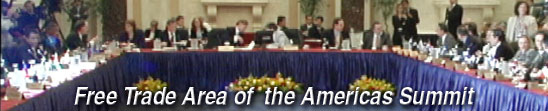
The Free Trade Area of the Americas, which the Bush administration is pressing to have cemented in place by January of 2005, is the next major offensive in this ongoing economic warfare the globalists are waging against America. If the FTAA is allowed to become a reality, millions of independent American businesses and tens of millions of American jobs will face certain extinction. Ultimately, the FTAA means engineered extinction for our freedom and national sovereignty as well. The FTAA must be stopped, if the people of the United States hope to remain a free, economically viable, and sovereign nation.
That is not an impossible task. If the picture described in this article were understood by just a small fraction of the nation’s opinion molders, the politicians would be scrambling to unyoke America from these schemes. Let’s remember that the Clinton administration and its internationalist cohorts were able to fasten NAFTA on America only after a hard-fought battle and that NAFTA narrowly passed the House by a vote of 234 to 200 — and then only after an underhanded campaign employing massive deception, bribery and extortion.
|