Welcome Mat for Terrorists
William F. Jasper

|
The New American, December 29, 2003
With Marxist regimes in Cuba, Venezuela, Brazil and Haiti, and Communist movements in other Latin American countries, the FTAA poses an enormous security nightmare. |
Could the proposed Free Trade Area of the Americas, now galloping toward completion, actually spur the spread of Marxist revolution throughout Latin America? Would a completed FTAA result in the political and economic merger of the United States with Marxist-run countries in the region, including, ultimately, Fidel Castro’s Communist regime in Cuba? Will the FTAA make it easier for terrorists from Latin America and throughout the world, including the Middle East, to enter the United States? The answer to each of these questions is a resounding — and alarming — yes.
Previous articles in THE NEW AMERICAN have reported on the destructive impact that this proposed "common market" for the Western Hemisphere would have on U.S. jobs and industry. The FTAA would vastly multiply the devastation already wrought by NAFTA, the WTO and other so-called free-trade agreements negotiated by the Clinton and Bush administrations. Millions of jobs and virtually every U.S. industry sector — from agriculture and basic manufacturing to information technology and financial services — are on the line. We have also exposed the blueprint behind the FTAA to use the trade issue as simply the opening step in an ongoing process that will lead to a hemispheric supranational government, just as the Common Market in Europe led to a merger of nations in the European Union.* This puts our Constitution and our very existence as a sovereign nation at stake.
Opening the Door for Terrorism
The FTAA, however, poses an additional enormous danger that should be of paramount concern to every U.S. citizen, especially in light of the terrorist attacks of September 11, 2001 and the ongoing terror war. For the past 40 years, Fidel Castro has maintained Havana as the center for international terrorism in the Western Hemisphere. He maintains close ties with every recognized terror regime — Iran, Syria, North Korea, Libya, Algeria and Lebanon as well as with Russia and China. He was one of Saddam Hussein’s most loyal allies and defenders.
Following the 9-11 attacks, Castro hosted a global terror summit in Havana that included representatives from the "axis of evil" regimes and top terrorist groups. And, unbeknownst to most U.S. citizens, Comrade Fidel is bosom buddy to the Marxist presidents of our new FTAA partners Brazil and Venezuela. These two regimes, along with several others in the area, have become terrorist havens for Hezbollah, Islamic Jihad, Hamas, the PLO, PFLP and other Middle Eastern and Islamic terrorist organizations.
If the U.S. Congress approves the FTAA, these terrorists, along with others in Latin America, will eventually have free access to the U.S. What’s more, the FTAA planners intend to bring Communist Cuba itself into the hemispheric union as well.
The plan for the FTAA would not even have gotten off the ground in 1994 if there had been any hint that Fidel Castro’s regime might some day be included in what then was being sold merely as a trade pact. President Bill Clinton knew that when he presided over the 1994 Summit of the Americas in Miami that launched the FTAA process. Florida’s influential Cuban-American community and their traditional anti-Communist allies would have forced Congress to torpedo any effort to lift the U.S. embargo of Castro, let alone give him the preferential trade status to be conferred on FTAA countries.
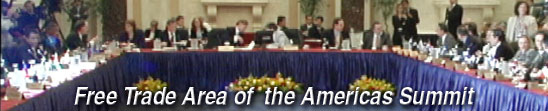
So Cuba, alone among the 35 countries of the Western Hemisphere, was pointedly excluded from the 1994 Miami summit and all succeeding FTAA gatherings, including the most recent Ministerial summit held in Miami during November 16-20, 2003. Castro’s exclusion, together with rosy assessments that envision a hemisphere growing ever more prosperous, stable and democratic, have won over many FTAA skeptics and opponents. A free-trade agreement promoting the free movement of capital, people, goods and services across borders (goes the argument) will create a rising tide of prosperity that will lift all boats — big and small businesses, the poor as well as the rich — in Latin America and the Caribbean. This, in turn, say the FTAA advocates, will undercut any residual attraction to the bankrupt policies of Marxism. The rhetoric has worked well. Cuban-American business leaders are among the most enthusiastic supporters of the trade pact. Republicans who claim conservative, anti-Castro credentials form the hard core of FTAA support in Congress.
However, many of the FTAA’s most fervent supporters are being taken for a ride. Besides the immense problems that the trade pact will cause the U.S. in terms of dislocation, job loss, market loss and trade deficits, there is also an enormous security issue that has been totally papered over. The FTAA’s architects know that Communist movements and terrorist organizations that were relatively quiet throughout the 1990s have roared back into action throughout the Americas. Openly Marxist, pro-Castro governments have taken over two of our most critical trading partners in the region: Brazil and Venezuela. Communist China is investing heavily throughout the region and controls key shipping ports, including the ports of Balboa and Cristobal strategically located at each end of the Panama Canal, and the huge new port in the Bahamas built by Beijing’s global acquisition agent, Hutchison Whampoa, Inc. A Communist madman runs Haiti. Colombia is tottering between narco-terrorists and "soft" Marxists. Peru faces a possible slide back into anarchy and terrorism. In Nicaragua, the Communist Sandinistas may well come back openly to power.
In addition, virtually every country in the proposed FTAA is awash in debt and beyond bankrupt. And we’ve barely scratched the surface. In short, Latin America is already an enormous security problem for the United States. Protecting our borders and getting some handle on the millions of illegal aliens now in our country are already daunting challenges. The FTAA architects would make the problem infinitely worse by accelerating the abolition of our borders. The hemispheric merger they are pushing would completely enmesh the political and economic systems of the region to allow free migration between countries, as now allowed in the European Union. To top it off, they intend to include Cuba in this new common market after all. Yes, all of the key players in the FTAA game plan have long supported normalizing relations with Fidel Castro, welcoming him into all international organizations, and showering his Communist regime with loans, credits and foreign aid. If the United States joins the FTAA, you can be sure that it won’t be long until all of those outrages become official U.S. policy.
FTAA — Castro’s Brainchild
And why shouldn’t Communist Cuba be a full-fledged FTAA member? After all, Comrade Fidel can legitimately lay claim to being one of the earliest proponents of this Marxist-Leninist concept, decades before the rest of us even heard of such a thing. Less than five months after taking control of Cuba, the bearded dictator advocated the creation of a common market for the Western Hemisphere. In a speech delivered on May 2, 1959 to an inter-American economic conference in Buenos Aires, Castro urged the United States to join in the creation of a so-called Latin American common market. He proposed that the U.S. provide $30 billion in credit over 10 years for the economic development of Latin America.
Incredibly, Castro’s proposal became U.S. policy. Herbert Matthews, Fidel’s leading champion at the New York Times, later wrote of Castro’s Buenos Aires speech: "The American delegation dismissed the idea with amused contempt. But less than two years later President Kennedy put forward the proposal for his Alliance for Progress, pledging $10 billion for the first ten years. Later President Johnson promised another $10 billion for the first ten years."
What we are now witnessing as the unfolding FTAA began as a revolutionary program of the Kennedy administration under the lofty sounding title of Alliance for Progress. The Alliance for Progress, designed on the pattern of the Marshall Plan, was established to funnel billions of foreign aid dollars to socialist parties and Communist movements in Latin America, with the aim of melding all of the region’s countries into a common market, just as the Marshall Planners had done after World War II in Europe.
Stripped of its phony rhetoric about "free markets," Castro’s support of a regional common market makes perfect sense; it is in complete accord with Communist strategy. "Divide the world into regional groups as a transitional stage to world government," Soviet dictator Joseph Stalin wrote in his book Marxism and the National Question. "Populations will more readily abandon their national loyalties to a vague regional loyalty than they will for a world authority. Later, the regionals can be brought all the way into a single world dictatorship...."
So Fidel was merely following his ideological masters. What most Americans will find astounding is that top U.S. government officials not only adopted the same program, but did so with the aim of establishing the same regional approach to global socialism. However, this scheme had to be sold to the American public as a cure to stop the spread of Communism in Latin America.
Unholy Alliance
The Kennedy administration was loaded with many of the same one-world ideologues and pro-Communists who had dominated the Roosevelt, Truman and Eisenhower administrations. This continuing claque of policymakers invariably saw allies in Stalin, Mao Zedong, Josip Broz Tito, Ho Chi Minh, Gamal Nasser and other Communists.
The Kennedy brain trust drew from the usual stable: the Carnegie Endowment for International Peace, the Brookings Institution, Harvard University, the Ford Foundation, and, most importantly, the Council on Foreign Relations (CFR). Adolph Berle, McGeorge Bundy, William Bundy, Arthur Schlesinger, Richard Goodwin, Lincoln Gordon and Walt Rostow — all CFR apparatchiks — together with other Establishment leftists, launched the regionalization effort for the Americas advocated by Stalin and Castro.
Historian Arthur Schlesinger described in his book A Thousand Days some of what he witnessed as a participant in that process. Schlesinger, a radical Fabian Socialist and New Dealer, recalled a Washington, D.C., meeting President John F. Kennedy and some of his advisers had with Dr. Cheddi Jagan, the Communist leader of Guyana. Kennedy and Jagan found much common ground, especially in their mutual admiration of one of Britain’s leading Fabian Socialist icons, Professor Harold Laski. Schlesinger writes:
Recalling Jagan’s words of admiration for Harold Laski on Meet the Press, Kennedy observed that he himself had studied for a term under Laski at the London School of Economics and that his older brother had visited the Soviet Union with him. Jagan replied that the first book of Laski’s he had read was The American Presidency; he considered himself, he added, a Bevanite. We all responded agreeably to this, citing Bevan’s … belief that the struggle of the future would be between democratic socialism and Communism....
Kennedy’s Latin American policy, crafted by his CFR brain trust, was based on this premise that the Western Hemisphere — and mankind in general — had only two viable options: socialism or Communism. It was a continuation of the CFR-hatched policies that had steered post-war Europe along the socialist track. To give this revolutionary plan a respectable face, the Kennedy administration resorted to a common ploy of governments, as well as institutions that aspire to govern: It set up a "task force" on Latin American policy. The man chosen to head the task force was Adolph Berle (CFR), a New Deal lawyer who implemented President Franklin D. Roosevelt’s "good neighbor" policy and later served as U.S. ambassador to Brazil.
Berle’s task force issued a report in 1961 that laid out what became, essentially, the FTAA program. It recommended that the United States support "a long-range economic plan for the whole hemisphere." This plan should provide "integrated development programs covering several years in advance, prepared first on a national basis … and then combined into a region-wide effort." The Berle report urged the U.S. to end its "doctrinaire opposition" to socialism and revolutionary movements and to encourage "diverse social systems in different countries." U.S. military force should not be used, it said, to "stabilize the dying reactionary situations." By which the authors clearly meant that anti-Communist allies in Latin America should not be assisted when under attack by Soviet-sponsored "progressive" forces. These "reactionary" regimes were presumed to be corrupt by virtue of the simple fact that they did not embrace socialism. However, according to the task force, the U.S. military may be justifiably deployed to aid a Leftist regime pursuing the socialist holy grail.
The Kennedy-Berle plan was officially launched as the Alliance for Progress at the Inter-American Economic and Social Council conference in Punta del Este, Uruguay, in August 1961. The U.S. representative at the summit, C. Douglas Dillon (a longtime CFR director and vice chairman of the board), found himself facing opposition to the scheme from virtually every country — except Castro’s Cuba. Schlesinger noted this was because "Cuba was in sympathy with many of the Alliance’s objectives...." Castro recognized the pro-Communist reality beneath the Kennedy administration’s anti-Communist rhetoric. Thus, says Schlesinger, "Word soon went round the conference that there were only ‘two left-wing governments present — Cuba and the United States.’..."
The Elite Castro Lobby
With billions of Alliance for Progress dollars voted by Congress, the administration began the process of luring, bribing and bludgeoning reluctant Latin American countries into the hemispheric merger. Additional U.S. taxpayer funds provided through the World Bank, the Inter-American Development Bank and the International Monetary Fund further greased the skids.
However, perhaps just as important to the success of the Alliance for Progress’ plan for hemispheric integration as official U.S. policy was (and is) the support provided by powerful private organizations. Foremost among these, in addition to the Council on Foreign Relations, is the Council of the Americas (COA). Officially established in 1965, just after the Alliance for Progress got up and running, the COA moved in to make sure the policies and aid dollars were advancing the objectives outlined by the Berle task force.
The COA was founded by (and for many years chaired by) mega-banker David Rockefeller. Mr. Rockefeller remains today as honorary chairman of the organization, while William R. Rhodes (CFR) serves as the COA’s current chairman. David Rockefeller was uniquely qualified to head this venture, having a few years before been a central player in the plan to regionalize and socialize Europe. In 1947 he had served as secretary of the CFR study group on "Reconstruction in Western Europe," what later became known as the Marshall Plan. That scheme to build the Common Market (now the European Union) was officially administered in Europe by Rockefeller’s longtime CFR colleague John J. McCloy.
The COA’s membership has included some of the top members of the CFR’s circles of power in government, business, the media and academe. The COA’s corporate members comprise a Who’s Who of business and finance: Bank of America, Citibank, AOL Time Warner, Ford, GM, Lucent Technologies, Coca Cola, Pepsico, McDonald’s, Microsoft, IBM, Johnson & Johnson, etc. With this kind of political and economic clout, the COA leadership has been well positioned to reward or punish Latin American business and political leaders. "The Council regularly hosts Presidents, cabinet ministers, central bankers, government officials, and leading experts in economics, politics, business, and finance," the COA’s website boasts. "This programming," it notes, "gives our members unique access to information and insights into the evolution of the region...." Indeed it does. And the COA and CFR have worked hand in hand to use this "unique access" to direct the "evolution of the region" in a corporate-socialist direction — while claiming to advance free markets.
Operating through the COA and other fronts such as the Inter-American Dialogue, the CFR has drawn most of Latin America’s movers and shakers into its sway. It even has national CFR affiliates throughout the hemisphere to push the process more directly. Page 12 of the CFR’s 2003 Annual Report features a photo of "The first Hemispheric meeting of the Councils on Foreign Relations … held in Buenos Aires, Argentina, March 30-31, 2003." Pictured are representatives from mini-CFRs in Argentina, Brazil, Canada, Chile, Mexico and Paraguay.
CFR Tells Lulu on Lula
The presence of well-known corporate giants and business moguls in the CFR-COA membership rolls leads many observers to conclude that these men are conservative businessmen who would have no truck with socialism and revolution. But in reality, these people are, by and large, not free market entrepreneurs but transnational corporatists. They know that the international regulations and agreements they promote favor huge economies of scale that will wipe out their smaller competitors and challengers. They bear no national allegiance; in fact, they support world government. They prattle endlessly about the virtues of globalization, global governance and international law — and support policies to implement the same.
The CFR establishment’s perspective on the Communist background and government of Brazil’s president Luis Inacio Lula da Silva, more commonly known as Lula, is typical of the continuing socialist program directed by these elites. On December 5, 2002, the CFR’s Kenneth R. Maxwell penned a blistering diatribe for the New York Review of Books taking on Lula’s U.S. critics. Mr. Maxwell is the "Nelson and David Rockefeller Senior Fellow for Inter-American Studies" at the CFR and the council’s director of Latin America Studies — ergo, the "expert’s expert."
Mr. Maxwell explained that he had returned from Brazil, where Mr. Lula had just been elected president in a tremendous upset. And Maxwell was upset that the "United States was not celebrating this remarkable demonstration of democratic civility."
"Lula’s triumph seemed like the realization of an American dream," wrote the CFR’s expert, and he couldn’t understand why U.S. conservatives were painting the new president as a dangerous, pro-Castro radical. He was irate that critics had linked Lula to the Sao Paulo Forum and had described the SPF as a center of international terrorism.
"No one I met in Brazil thinks that Lula would see Cuba, let alone Venezuela, as a model," said Maxwell. "Even the best-informed experts I talked to in Brazil had never heard of the Sao Paulo Forum," he insisted. And "the charge that it is a secret ‘Castroist’ cabal, aimed at promoting international terrorism, is exaggerated to say the least," he averred.
For the record, the Sao Paulo Forum is indeed a Castroist cabal that may justly be called a continuation of the terrorist Tricontinental network Fidel launched in the 1960s. Its membership includes such notorious terrorist groups as the FARC and ELN of Colombia, the MIR of Chile, the FMLN of El Salvador and the FSLN of Nicaragua, as well as the Communist Parties of Argentina, Brazil, Chile, Colombia, Cuba, Peru, the United States, Uruguay and Venezuela. The first SPF gathering was held in Sao Paulo, Brazil, and was hosted by Lula and his (Communist) Workers Party. Lula has since then publicly attended many of the SPF’s annual confabs, including the one hosted by Fidel Castro in Havana in December 2001. His economic and political policies indicate he does indeed see Cuba and Venezuela as models for his socialist state.
All of this information on Lula and the SPF — and much more besides — is publicly available on Communist and pro-Castro websites on the Internet. How did all of this escape the notice of the CFR’s top Latin American expert? Interestingly, it didn’t; Maxwell simply chooses to dismiss it as irrelevant. He acknowledges:
No one doubts that the stakes involved in the election of a candidate of the left in Brazil are high and the risks great, or that Lula and the Workers Party have longstanding socialist credentials, or that he has met with Castro, or received a victory "Bolivarian saber" from Venezuelan president Chavez, or that his closest adviser, Jose Dirceu, was trained as a guerrilla in Cuba and returned to Brazil decades ago with a face altered by plastic surgery to disguise him.
Maxwell and his fellow CFR revolutionists would have you believe all that is superfluous. Likewise, the fact that Lula’s first official guests as president of Brazil were Fidel Castro and Venezuela’s Marxist President Hugo Chavez. But Maxwell wouldn’t see that as a problem, since the CFR favors normalizing relations with Castro, just as it led the charge to aid, and trade with, Communist China, Saddam’s Iraq, and Communist Vietnam.
Mr. Chavez has also been given remarkably friendly treatment by the CFR experts, though he makes no attempt to conceal his Communist colors. Since taking power in 1999, Hugo Chavez has marched Venezuela steadily leftward toward a Castro-type dictatorship. With him go Venezuela’s oil reserves, the world’s largest proven deposits.
Chavez has publicly aligned himself with the terrorist-sponsoring regimes of Cuba, China, Iraq (under Saddam Hussein), Iran and North Korea. He has repeatedly unleashed his "Bolivarian Circles," armed thugs and neighborhood spies, patterned after Castro’s Committees for the Defense of the Revolution, to beat, intimidate and murder his opposition.
Lula and Chavez appear to be throwing left-handed wrenches into the FTAA works with their revolutionary rhetoric, their demands for trade exemptions and concessions, and their pursuit of their own South American common market known as Mercosur. But that is a feint supported by the COA-CFR elitists. Contrary to the claims of some observers, the regional Mercosur is not incompatible with FTAA.
Indeed, one of the top FTAA architects, C. Fred Bergsten (CFR), has repeatedly soothed his fellow globalists who have become concerned that sub-regional trade areas would undermine the larger hemispheric plan. To the contrary, says Bergsten in Open Regionalism, a 1997 working paper from the Institute for International Economics, these smaller trade zones actually create "incentives for other regions and individual countries to follow suit and thus to ‘ratchet up’ the global process."
Thus the CFR elites are not unduly bothered by heated bombast from the likes of Lula, Chavez or Haiti’s President Jean-Bertrand Aristide. In fact they are happy to shovel billions more taxpayer dollars into these Marxist hellholes, as these regimes push their own regional trade pacts. According to Bergsten, it is only necessary to assure that these "regional agreements will in practice be building blocks for further global liberalization rather than stumbling blocks that deter such progress."
|