FTAA Falters on Road to 2005
William F. Jasper

|
The New American, December 15, 2003
The recent negotiation impasse at the Free Trade Area of the Americas summit in Miami shows that the globalist plan to merge the hemisphere can still be stopped. |
Plans to merge 34 countries of North and South America and the Caribbean into a supra-national government modeled after the European Union hit some snags at the recent hemispheric summit in Miami. However, the Bush administration is continuing the Clinton administration’s commitment to complete a formal agreement on the merger by 2005. To this end, it has announced a stepped-up schedule to negotiate a series of bilateral, multilateral and regional trade agreements aimed at achieving the hemispheric merger piecemeal and applying pressure to countries that are resisting economic and political convergence.
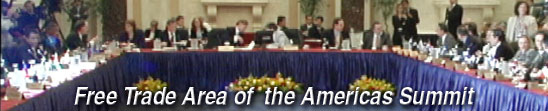
The weeklong Free Trade Area of the Americas (FTAA) summit in Miami ended abruptly on Thursday, November 20, a day earlier than scheduled. Though U.S. Trade Representative Robert Zoellick and many of his foreign counterparts attending the conference termed the gathering a success, it was clear that they were putting a happy face on a negotiated framework agreement that had become mired in trade disputes and had fallen far short of expectations.
At a surprise press conference hurriedly called Thursday night, Mr. Zoellick announced that the trade and finance ministers had completed their work earlier than expected. “We got our work done a few hours early,” he announced. “We are moving the FTAA … into a new phase. We are negotiating it, not just seeking it.” Brazil’s Celso Amorim, who co-chaired the summit with Zoellick, contrasted the event’s conclusion with the collapse of the World Trade Organization (WTO) talks in Cancun, Mexico, in September. The Cancun summit ended in deadlock, as several countries walked out over disputes concerning agricultural tariffs and subsidies, intellectual property rights and other hotly contested issues. “The great difference [at Cancun] is that everyone was dancing to the beat of their own drum,” said Amorim. “Today we have reached a result that was all common.”
But the image of sweet unity and harmony projected by Zoellick and Amorim was an attempt to cover over contentious issues that had threatened to turn Miami into another Cancun donnybrook. The Miami declaration provides the framework for the next round of FTAA negotiations, which will begin early next year. The document reaffirms the commitment signed by President George W. Bush and other hemispheric leaders at the Quebec Summit of the Americas in 2001 to achieve a final agreement by January 2005, with the FTAA going into effect by the end of that year. The declaration gives a deadline of September 30, 2004 for final tariff negotiations but sets no dates for other matters, such as environmental regulation, labor codes, immigration and health care — all of which have been proposed for FTAA jurisdiction.
To avoid an impasse, the U.S. agreed to a weaker treaty draft that would allow countries to opt out of FTAA regulations they don’t like. The agreement, for example, allows Brazil to opt out of the FTAA on intellectual property rights, opening services markets, and new laws protecting foreign investors. Zoellick pointedly contested critics’ characterizations of the Miami agreement as “FTAA Lite” or “ALCA Lite” — ALCA being the Spanish acronym for FTAA. “I don’t accept your presumption that what we negotiated was an ALCA Lite,” Zoellick told Latin American critics during a Thursday afternoon session.
However, the U.S. trade representative’s actions belied his words. On November 19, after negotiations had reached a deadlock, Zoellick announced that he would launch a new flurry of negotiations for bilateral trade pacts with at least six countries. Those named were the Dominican Republic, Panama, Bolivia, Colombia, Ecuador and Peru. Although Zoellick has been pursuing bilateral trade pacts with these and many other countries over the past two years, the announcement signaled a new high-pressure effort by the administration to draft reluctant countries into the FTAA with the threat of being isolated from access to the coveted U.S. market.
David Lewis, a Washington-based trade adviser attending the Miami FTAA business forums, explained the U.S. bilateral strategy to the Miami Herald this way: “Basically what it says is, ‘OK, if we can’t close a good FTAA, we’ll close some good bilateral [treaties].’ Before you know it, you may not have an FTAA. But what you have in the bilaterals may be equal to an FTAA.”
Amalgamating the Americas
That, of course, is the plan. The FTAA architects have designed the envisioned organization as the hemispheric equivalent of NAFTA (North American Free Trade Area), which now encompasses the United States, Canada and Mexico. It is also planned as a regional adjunct of the WTO. The FTAA proponents intend that their new creation will expand rapidly beyond trade issues and, following the model of the European Union, absorb the sovereign nations of the Western Hemisphere into a supranational government.
The crucial sovereignty issue was a major bone of contention at the 2001 Quebec summit. In an April 23, 2001 Associated Press story entitled “Biggest Obstacle to Selling Trade Pact Is Sovereignty,” writer David E. Sanger highlighted the central issue at stake in the so-called free-trade pact. “The biggest problem,” Sanger noted, “comes down to one word: sovereignty.”
As with NAFTA, the FTAA would turn over control of trade issues, as well as a growing list of add-on issues, to an international bureaucracy that can override national and local laws and constitutions. But there was virtually no mention of sovereignty at the Miami summit, at least none that made it out to the press.
The conference was one of the most hermetically sealed trade summits ever convened, with almost all of the sessions taking place behind closed doors at the Intercontinental and Hyatt Regency hotels in Miami’s downtown oceanfront. Due to the violent riots that had plagued the Seattle WTO summit, the Quebec FTAA summit and other international gatherings, the Miami conference took place within a police cordon that sealed off several city blocks behind barricades and an overwhelming police presence on land and sea and in the air. No one was allowed into the area unless registered with the event and in possession of an official photo I.D. issued by FTAA organizers. Even registered members of the media were severely restricted and forced to go through repeated searches, metal detectors, and “wandings” for the few press conferences and photo ops that were made available.
The FTAA media center in the Hyatt was provided video feeds of some of the speeches, but most of the sessions took place two blocks away at the Intercontinental and were off-limits to the press. When we were allowed to attend events, we were escorted by guards and not permitted to mingle with any of the conference delegates. When the official sessions ended, delegates were usually spirited off to dinners and evening events that also were closed to the press. As a result, even those of us who were staying in the Hyatt, where most of the delegates also were staying, found little opportunity to interview the main FTAA participants. This was according to plan; the summit organizers wanted to be sure that exposure of delegates to the media was kept to an absolute minimum and that news coverage would be largely reduced to regurgitation of official FTAA press releases. With this tightly controlled media setup, FTAA organizers could greatly curtail expressions of dissent, present a general image of agreement, and make it appear that the radical street protesters were the only opposition to the “trade liberalization” proposed under the FTAA.
Controlled “Opposition”
The only other voices of opposition heard in Miami came from supposed conservative quarters in the business and political communities, where the criticism was that the declaration did not go far enough! The U.S. Chamber of Commerce, dominated by large corporate influences that stand to gain by moving even more of their production to cheaper Latin American venues, warned that Zoellick’s new bilateral strategy “must not distract from the effort to complete the Free Trade Area of the Americas, which remains our top hemispheric priority.”
Likewise, the National Association of Manufacturers (NAM) expressed concern that the watered-down agreement might not be acceptable to them. “This is not the way we want to go,” said NAM international vice president Frank Vargo. “If it is not a high-quality agreement, we are not going to support it.” By high quality, Vargo means an FTAA with broad powers and real regulatory teeth. It is unlikely that the hundreds of thousands of small- and medium-sized businesses that make up the U.S. Chamber and the NAM fully realize that their leaders are lobbying to saddle them with an unaccountable international regulatory bureaucracy. Those American businesses are already staggering under regulatory overload. If the FTAA goes through, they will not only find themselves hit with an ever-increasing welter of FTAA regulations, mandates and lawsuits, but they will see what remaining market share they now have eroded by a flood of less expensive foreign products. Of course, many of those products will come from the foreign plants of big corporate NAM and Chamber members that are not subject to the same socialist burdens forced on the smaller members who produce domestically.
Many of these same corporate business leaders also expressed dismay that the Miami summit failed to decide on a location for the FTAA Secretariat, the new bureaucracy that would administer the planned explosion of “international law” spawned by the new organization. The location of the Secretariat was one of the highly anticipated outcomes of the summit that failed to materialize. Miami appears to be the leading candidate for the permanent headquarters, and officials for Florida and the City of Miami have been campaigning for this political plum for the past several years.
In view of the “FTAA Lite” accord, many delegates openly expressed doubt that the FTAA would have sufficient regulatory duties to justify a large and impressive staff. Not to worry, said Carl Cira, the FTAA would still be a force to reckon with. Mr. Cira, the director of the Summit of the Americas Center at Florida International University, insisted: “It would be the World Trade Organization of this hemisphere. It’s still worth fighting for that.”
The NAM’s director of international trade policy Scott Otteman was less enthusiastic than Cira. “I would have more respect for it if it was a secretariat administering a broad, comprehensive agreement,’’ Otteman stated. Chuck Cobb, the leading cheerleader of the Sunshine State’s business community, has urged his fellow Floridians to see a silver lining in the weaker FTAA declaration. According to Mr. Cobb, the “bright side” is the possibility that the profusion of loopholes and exceptions in the agreement will make it more complex and therefore require a larger staff than otherwise would be necessary.
The Miami Herald reported:
Florida FTAA Chairman Chuck Cobb and others counter that the looser treaty proposed Wednesday — which would let countries opt out of FTAA rules they don’t like — could spawn an even larger bureaucracy for the headquarters, since it would have a more sprawling matrix of regulations to administer.
So why are these business leaders so anxious to subject themselves to the ministrations of a new level of international bureaucrats? Many in the business community have undoubtedly succumbed to the fabulous promises of immense wealth to be made from exporting U.S.-made products to these new markets. The same promises were made concerning NAFTA and the WTO. Instead, we have seen an accelerated hemorrhage of jobs, manufacturing and technology to Asia, Mexico and Latin America. How could any businessman consider erecting a new WTO for this hemisphere to be a good thing? Why would a representative for the manufacturing industry want a new regulatory monstrosity to be given “broad, comprehensive” administrative authority? Why would a business leader hope for “an even larger bureaucracy” with “a more sprawling mix of regulations”?
The answer is that, like Mr. Zoellick, most of these business leaders pushing the FTAA free-trade scam are corporate, one-world socialists who know that the trade policies and regulatory regimes they are supporting will wipe out most of their smaller competitors. They also know that each of these so-called free-trade agreements includes billions of dollars for the taking, ladled out by USAID, the World Bank, the Inter-American Development Bank, the International Monetary Fund and other entities to those corporations with the right political connections.
Like Mr. Zoellick, most of the leading lights of the FTAA crusade are members of the Council on Foreign Relations (CFR), which has been in the forefront of virtually every effort to promote regional governance schemes as a stepping stone to world government.
Global Governance
The FTAA is a prime example of the favored model of “transgovernmentalism,” described by Harvard Law School Professor Anne-Marie Slaughter (CFR) in the September-October 1997 issue of Foreign Affairs, the CFR journal. In her essay entitled “The Real New World Order,” Professor Slaughter declared that “Transgovernmentalism is emerging as the real new world order, rapidly becoming the most widespread and effective mode of international governance.”
Transgovernmentalism is the developing wave of supra-national government networks that incorporate big business and non-governmental organizations (NGOs) into the governing mix. According to Slaughter, these “government networks are government for the information age. They offer the world a blueprint for the international architecture of the 21st century.” “The result,” she says “is not world government, but global governance.”
According to Slaughter, this transgovernmentalist strategy of networking has the advantage of not providing a centralized target like the UN for conservatives to demonize. However, Slaughter goes on to contradict her nonsensical governance-government distinction by admitting that the transgovernmental model she champions is indeed a form of world government. The new networks, she says, “can work with their subnational and supranational counterparts, creating a genuinely new world order in which networked institutions perform the functions of a world government — legislation, administration, and adjudication — without the form.”
Of course, once the “functions of a world government” are established in a network of institutions, it is a rather elementary matter to formalize an actual world government in a concrete, centralized structure. While many of the business leaders chasing the elusive trade dollar may not see this design behind the FTAA, you can be sure that Robert Zoellick, Anne-Marie Slaughter and their fellow one-worlders at the CFR most certainly do.
|